Who Cares about Privacy?
In the 2010s, a sizable minority of people genuinely cared about digital privacy. It was during these years that the public learned about the Snowden leaks (2013); The Intercept was founded (2014); the GDPR was written (2016); and the term "surveillance capitalism" entered the vernacular (2018). Cyberpunk experienced a renaissance, inspiring numerous movies, TV shows, and video games. People were scandalized when Google dropped its motto of "Don't be evil." And in the wake of the 2016 election, America's cultural and intellectual classes promoted anti-authoritarianism. As I'm writing this, I'm preparing to make a quiche, and don't have time to list all the other ways in which digital privacy was culturally relevant: but you can probably recall some.
It's now 2026 and people seem far less concerned about privacy, at least in my corner of the world. This is because all the grievances that were raised in the 2010s have been addressed: smartphones no longer passively track your location and listen to you; governments don't attempt to ban encrypted messaging; speech on social media is no longer monitored and influenced by obscure algorithms; and Silicon Valley has stopped trying to implement predictive policing.
This is a joke, of course. It's obvious that all these issues have only worsened, in spite of valiant legislation like the GDPR, which has succeeded in covering the web with 'accept cookies' banners, and probably in extorting fines from little startups in Provence. Big tech is hungrier than ever for all your data. It used to be that personal data could predict your desires and fears, being thus of value to advertisers and propagandists; but now it can also be used to train generative AI. And sure, AI receives plenty of negative press, but rarely from a privacy-conscious perspective.
So between ca. 2019 and now - an interval of 7 years - the public lost interest in digital privacy. The cause may be the same one attributed to most phenomena of this decade.
The Pandemic, 2020 - ???
Some people believe the covid-19 pandemic hasn't ended yet. I remember at its onset imagining a point 1-5 years in the future when they would announce that it was all finally over. And maybe they did, but I stopped paying attention.
The advent of a global pandemic sidelined public interest in digital privacy. Suddenly, contact tracing apps, digital passports, and censorship of social media were all on the table. Plenty of people rejected these ideas, but they weren't the ones who mattered. Their ideas were branded as low-status and antisocial by the formerly privacy-conscious intelligentsia, who agitated for governments and companies to engineer a high-tech digital panopticon in the name of public health.
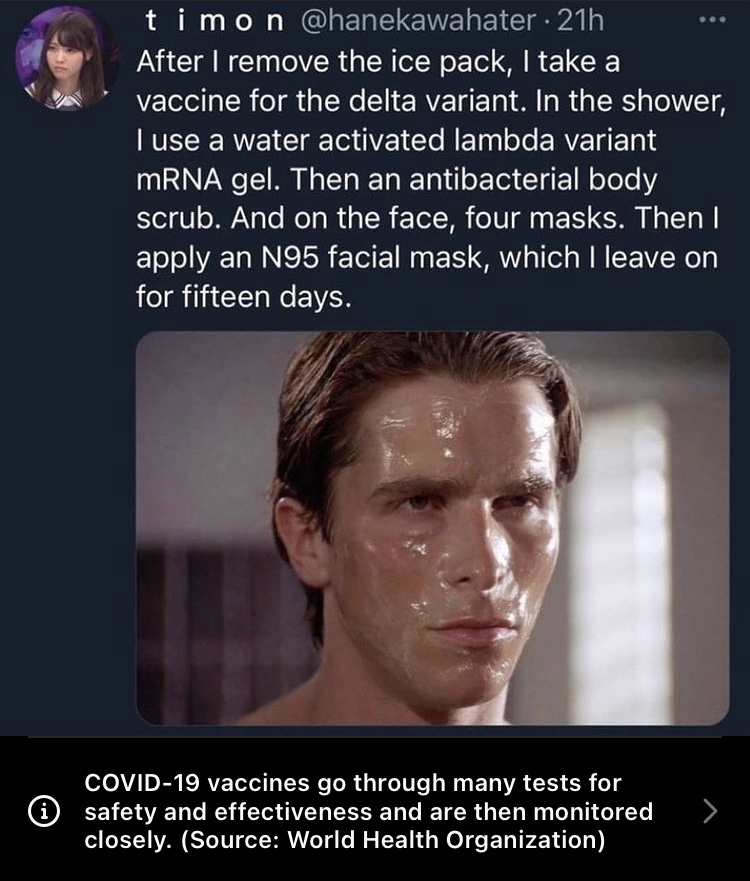
A great example I found is this researcher, who had one of those social media accounts where he promoted his work but never interacted with anyone. Since 2020, he's written tons of papers on fighting misinformation through tracking, censorship, and psychological manipulation: https://archive.is/FLBmF.
In fact, I went to college during this period, initially aspiring to become a professor. Phenomena like the above played a huge role in turning me away from that. The university is an ideological monoculture, populated by spineless technocrats, and you have to (figuratively?) kiss a lot of asses to get anywhere.
Ok, enough venting of spleen.
Opposing the intelligentsia's vision was a populist-libertarian rabble who watched demonetized youtube videos and listened to Joe Rogan podcasts. Certain figures from Big Tech, notably Elon Musk and Peter Thiel, served as this group's champions. While they opposed pandemic restrictions, Musk et al. have no interest in digital privacy, because they're in the business of data collection and have close ties to defense agencies, who number among their customers.
Now US politics is led by two factions who both oppose privacy, and any serious interest in privacy has been relegated to the fringes, after less then a decade of real salience.
In Conclusion
Smile, you're on camera!